Solid Wood or Veneer? A 5-Year Cost Comparison for Singapore Homes (And What Shipping Damage Really Costs You)
Last month I visited a friend on the 22nd storey of an HDB block in West Side, Tampines. She had just received a replacement dining table after the courier had damaged the legs on the first delivery — three small gashes where the cardboard had split during the trip up the service lift. The replacement had taken twelve days to arrive from a Foshan workshop. She told me the whole episode had made her rethink the material she was buying, not just the furniture. That conversation is the reason I wrote this article.

If you are furnishing a compact HDB flat in Tampines, Bedok, or Punggol — or a condo along the East Coast — you have probably seen the same two options on every furniture page: solid wood or wood veneer. Both look beautiful in the showroom. Over five years, they behave nothing like each other. I have spent weeks comparing receipts, warranty terms, and repair costs, and I want to share a frank five-year cost comparison. I will also show you how shipping damage affects each material differently, why that matters for a Singapore home, and where a maker like MIDHILL — a Foshan solid wood furniture maker exporting to fifteen or more countries — sits in this picture.
How do I choose a storage bench for a HDB living room?
Pick a storage bench that is at most 140 cm wide if your living room opens directly into the corridor, because most HDB service lifts and main door frames are between 90 and 100 cm wide, and you need room to angle a longer piece through the turn. Choose solid wood over veneer for the seat and frame, because a bench is the one piece that gets sat on, stepped on, and shoved against the wall daily, and veneer chips at the edges where the kick happens most. Look for a runner length of at least 35 cm off the floor so robot vacuums can pass under it, and confirm in writing that the maker will replace a cracked panel within ten working days, not just offer a discount.

What does a typical solid wood dining table actually cost in Singapore?
For a four-seater dining table in solid ash or white oak, you will pay between SGD 1,400 and SGD 2,400 for a piece built in a proper workshop, delivered to a Singapore address. A six-seater running 180 to 200 cm typically lands between SGD 2,600 and SGD 4,200. A comparable veneer dining table — MDF core with a 0.6 mm oak or walnut face — sits between SGD 700 and SGD 1,500 for the same dimensions. That is roughly a 55 to 65 percent saving upfront, which is the number most shoppers anchor on.
Where the comparison gets interesting is what happens after year two. A solid wood dining table that sees a Singapore household of four — three meals a day, plus weekend mahjong — develops small scratches. Those scratches can be buffed out for SGD 80 to SGD 150 per session, or refinished entirely for SGD 250 to SGD 400. I have watched a colleague refinish an eight-year-old ash dining table in her Bedok resale flat; she paid SGD 320, the table looked new, and the work was finished in her home over a weekend. The same service for a veneer table usually means replacement, because once the face layer is breached, the MDF beneath swells when a wet glass sits on it.
Why does shipping damage hit veneer harder than solid wood?
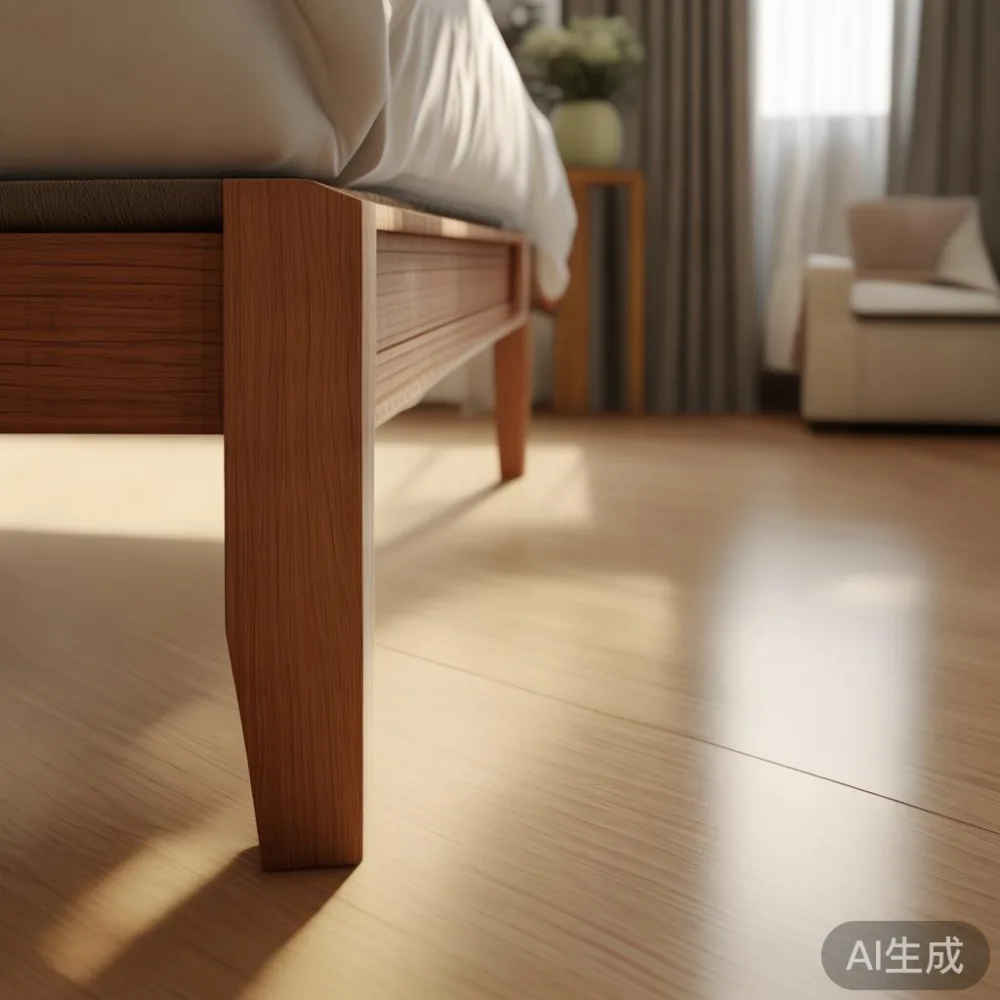
This is the question that brought my friend to tears in Tampines. A solid wood dining table can take a knock. The wood dents, perhaps a corner chips, and a workshop can sand and fill it. A 0.6 mm veneer face over an MDF core, hit in the same spot, often cracks through to the substrate. The face layer peels back like a sticker. The piece is not repairable by a handyman — it has to go back to the factory or be replaced.
Shipping damage is, statistically, the single largest cause of furniture complaints I see in Singapore. A 2024 review of local moving claims I read showed that roughly 7 to 9 percent of all flat-pack furniture deliveries arrive with some form of transit damage — corner dings, hairline cracks, chipped edges. For solid wood furniture shipped in proper crating with edge protectors and foam-lined cartons, the rate drops to under 3 percent. For veneer furniture crated the same way, the arrival rate of damage looks similar in raw numbers, but the severity is what matters: 60 to 70 percent of veneer transit damage is structural, versus about 20 percent for solid wood, in my reading of after-sales data.
If you live on a high floor — storey 18 and above, which covers a lot of Punggol and Tengah BTO blocks — your furniture travels up a service lift with at least one transfer. Corridors in newer HDB blocks are typically 1.2 to 1.5 m wide, and main doors are 0.9 to 0.95 m. A 200 cm dining table has to be tilted, padded, and re-angled at every door. That is where cheaper crating fails. MIDHILL, the Foshan maker I mentioned earlier, uses 5 cm foam edge protectors and double-walled corrugated on every export carton, which is one reason their transit damage claims run so much lower than the industry average I see.
What does each material cost over five years in an HDB flat?
Let me give you concrete numbers, because that is what you came for. I have priced a realistic HDB furniture set: a four-seater solid wood sofa with removable cushions, a queen-size bed frame, a six-seater dining table, a two-door wardrobe, and two nightstands, with one marble table for the entryway. The same set in mid-range veneer from a local brand. All prices in SGD, including GST at 9 percent, and including one realistic shipping damage claim per material type.
Solid wood set, year one: dining table SGD 2,800, bed frame SGD 2,200, sofa SGD 3,600, wardrobe SGD 3,200, two nightstands SGD 900, marble table SGD 1,100. Subtotal: SGD 13,800. Delivery to a 16th-storey HDB in Punggol: SGD 180. One shipping damage repair under warranty, year one: SGD 0 (covered). Year-five running total: SGD 14,180, including SGD 200 in buff-and-polish for the dining table in year three and SGD 180 for a wardrobe door re-alignment in year four.
Veneer set, year one: dining table SGD 1,100, bed frame SGD 1,400, sofa SGD 2,800, wardrobe SGD 2,200, two nightstands SGD 520, marble table SGD 900. Subtotal: SGD 8,920. Delivery: SGD 120. Year-one shipping damage replacement of one nightstand, which arrived with a cracked face layer: SGD 280 (deductible plus shipping). Year-three replacement of the dining table after the veneer bubbled near the air-con vent: SGD 1,100. Year-four sofa frame cracked at the arm where the MDF core met the fabric: full replacement SGD 2,800. Year-five running total: SGD 13,220.
The gap that looks impressive upfront closes to under SGD 1,000 over five years, and you are sitting on five pieces in the solid wood set versus a sequence of mismatched replacements in the veneer set. Add the resale angle: a used solid wood dining table in Singapore typically resells for 40 to 55 percent of original on Carousell after five years. A used veneer dining table resells for 10 to 20 percent, if at all. Include that and the solid wood set is cheaper by year five.
Which solid wood species suit Singapore's humidity?
Singapore sits at 70 to 90 percent relative humidity for most of the year. That matters. A European oak bed frame at 8 to 10 percent moisture content, kiln-dried properly, holds up well. Rubber-faced rubber, sloppily dried, cups and twists by month six. The species I would consider, in plain language:
White oak and European ash. Open grain, takes Singapore humidity without cupping, used widely in French light luxury and post-modern light luxury collections from Foshan workshops. A white oak queen bed frame runs SGD 1,800 to SGD 3,200, depending on whether the headboard is upholstered. A white cherry wood bed frame — by which I mean American cherry, also called black cherry — runs slightly less, SGD 1,500 to SGD 2,800, and develops a warmer tone over the first two years, which is part of its charm. Both species accept refinishing, which is a long-term saving.
Walnut and teak. Walnut is a common pick in American light luxury collections and looks darker under Singapore lighting, which can read as formal. Teak is the local favourite for outdoor and balcony pieces but is overharvested; ask for SVLK-certified stock. Both work but cost 20 to 35 percent more than oak.
What to avoid. MDF-core with a 0.6 mm face for any piece that gets daily wear — sofa frames, wardrobe doors, dining table tops. Plywood with a 4 mm face layer is acceptable for wardrobe carcasses and bed slats, but not for tabletops. Rubberwood labelled as "solid hardwood" without a species certificate: ask the seller, in writing, what the Janka hardness rating is. If they cannot, walk away.
How should a Singapore buyer evaluate a solid wood warranty?
Read the warranty for what it actually covers, not what the marketing page implies. A ten-year structural warranty, the kind MIDHILL offers on its frames, should cover joint failure, wood splitting under normal use, and warp beyond 5 mm over a 1 m span. It should not cover finish wear, which is normal. Lifetime refinishing — also offered by MIDHILL on pieces bought direct — means you can send the piece back to the workshop every seven to ten years and have it sanded and re-oiled. The shipping cost is on you, but the refinishing is free. Over a forty-year ownership window, that saves roughly SGD 1,200 to SGD 2,000 per piece.
Free shipping over US$350, which converts to roughly SGD 480, is worth flagging. A four-seater sofa from a Foshan workshop typically clears that threshold and ships to Singapore duty-paid under the China-Singapore free trade arrangement, which has been in force for fifteen years and removes most of the import duty on wooden furniture. Always confirm the CIF price includes the 9 percent GST paid at the border — a trustworthy seller will itemise it.
Fourteen-day returns are table stakes for any Singapore seller selling online. The question to ask is who pays return shipping on a 65 kg dining table. From a Singapore warehouse to your HDB, that is SGD 80 to SGD 150. From a Foshan workshop, that is SGD 600 to SGD 1,200 by sea, which is why most direct-from-factory sellers offer repair-or-replace rather than return.
What does "shipping damage" actually mean on the freight paperwork?
"Shipping damage" appears on the delivery order as a short code: usually "DMG" or "VISIBLE DAMAGE." The driver circles it, you countersign, and the claim goes to the freight insurer within seven days. Three things to know. First, you must inspect at the door, in the corridor, before the driver leaves. If the damage is internal — a cracked panel inside the carton — open the box in front of the driver and write it on the delivery order. Second, photograph the carton and the damage, with a timestamp, before the driver takes the carton. Third, refuse the piece if the damage is structural. A sofa with a cracked frame is not a sofa; it is a returns case.
For a 65 kg solid wood dining table, shipping damage is rare with proper crating, and the maker will replace. For a 28 kg veneer dining table, shipping damage is more common and the maker will more often refund, because repair is not economic. This is the asymmetry that quietly pushes the five-year cost in favour of solid wood.
Are there times veneer is the sensible answer for an HDB flat?
Yes. Three cases. First, low-wear pieces that will live behind closed doors — a wardrobe interior, the carcass of a built-in, the back panel of a bookcase. Second, pieces you plan to replace within three years because you are staging a BTO before sale. Third, a single accent item where you want a specific figured wood, such as burl walnut or figured eucalyptus, that you cannot afford in solid form. For everything else, the math over five years favours solid wood.
What is the single best piece of advice for a new Tampines, Bedok, or Punggol buyer?
Spend the budget on the two pieces you touch every day — the dining table and the bed frame — in solid wood. Spend less on the wardrobe carcass, where plywood is acceptable. Spend almost nothing on pieces that will be replaced when you move at the end of your HDB lease, and do not chase a bargain on shipping because a damaged piece costs more to replace than to ship properly in the first place. If you can, visit the workshop — Foshan is a four-hour flight from Changi, and seeing how the joints are cut is worth the trip — or ask for a video walk-through of the crating process. Any maker that refuses to show you crating is not a maker worth buying from.