How Singapore Furniture Deliveries Get Damaged — and What to Do Before Dispatch
Learn how to prevent shipping damage for furniture delivered to Singapore, with practical checks for cartons, humidity, access, assembly and claims.
- Why does furniture get damaged when it is shipped to Singapore?
- How can I check furniture for shipping damage before the delivery team leaves?
- Which packaging methods protect furniture during an international shipment?
- How do HDB and condo access affect furniture delivery damage?
- What should be included in a furniture delivery and damage policy?
- How much does furniture delivery to Singapore cost, and what drives the price?
- Can humidity damage solid wood furniture after it arrives in Singapore?
- How should I assemble delivered furniture to avoid causing new damage?
- What should I do if furniture arrives damaged in Singapore?
Why does furniture get damaged when it is shipped to Singapore?
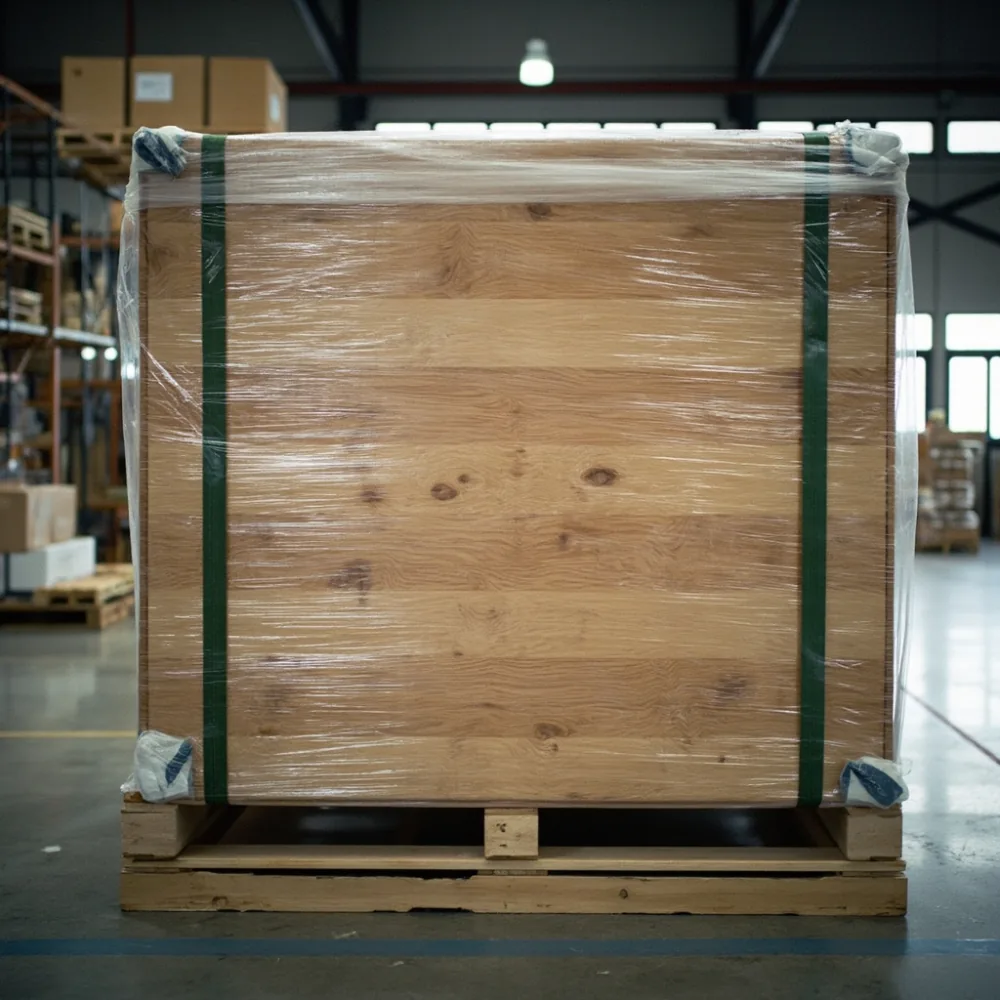
Where damage usually happens
Why Singapore conditions matter
I have seen more furniture damage during packing, unloading and final placement than during a normal year of use. A dining table may leave the factory with sound joints and arrive with a split top, a sofa frame may twist, or a cabinet door may no longer close. The problem is rarely one dramatic event. It is a chain of small pressures: a carton is dropped, a protective wrap tears, a pallet shifts, and someone carries the piece upstairs without noticing a cracked joint.
For shipments to Singapore, moisture is another factor. Long sea journeys pass through changing climates, and a container can develop condensation if the goods are packed before they are fully acclimatised. This matters most for solid wood furniture, flat-pack panels, veneer and any product with MDF or plywood cores. Water stains may appear after arrival even when the outer packaging looks dry.
- Factory damage: impacts during handling, loading or storage before the container leaves.
- Transit damage: shifting cargo, crushing, abrasion and port handling.
- Delivery damage: trolley damage, narrow staircase turns, dropped legs and incorrect assembly.
- Post-delivery stress: timber movement or finish changes after the piece enters a humid apartment.
I treat the delivery appointment as the start of inspection, not the end of the supplier’s responsibility. The condition report should happen before the team leaves or immediately after unloading, with photographs taken before unpacking.
How can I check furniture for shipping damage before the delivery team leaves?
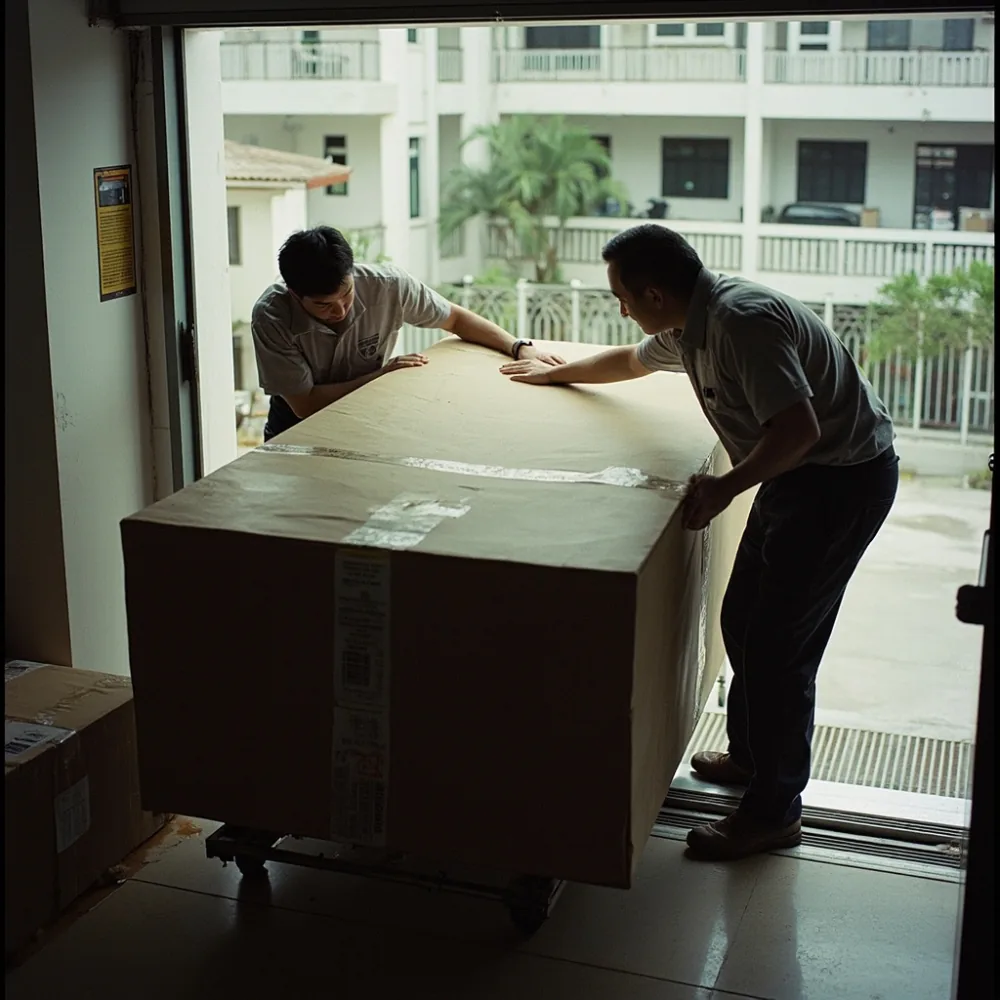
Inspect before unpacking
Check the parts that usually fail
Before signing the delivery sheet, ask the team to place the item where you can inspect it. Do not rush to sign first and inspect later. I photograph the full item, the pallet or carton, the delivery label and every visible mark. If there is a crushed corner, tear, damp patch or shifted package, I record it on the electronic or paper delivery note and request a written incident reference.
For a leather sofa, I check the frame under the cushions, stitching, arm edges, feet and the underside. For a solid wood dining table, I look beneath the top for splits near the joints, then check that each leg is straight and secure. A cabinet should have flush doors, aligned runners and tight handles. I also compare the piece with its published dimensions and finish photograph, since an unauthorised finish change is easier to dispute than an imperfect colour that was agreed in writing.
- Capture the item in good light, including close-ups of each alleged defect.
- Record the defect in objective words: “12 cm scratch”, “left rear corner crushed”, or “drawer travels only 8 cm”.
- Photograph serial numbers, labels and packaging so the item can be matched to the order.
- Test movement and assembly only when safe; do not force a swollen particleboard joint.
- State on the delivery note that acceptance is conditional on the listed damage being addressed.
If the driver refuses to wait, take timestamped photos as soon as the item is brought inside, then send them to the seller before the end of the day. Fast reporting gives the supplier a chance to compare the photographs with its factory and warehouse records.
Which packaging methods protect furniture during an international shipment?
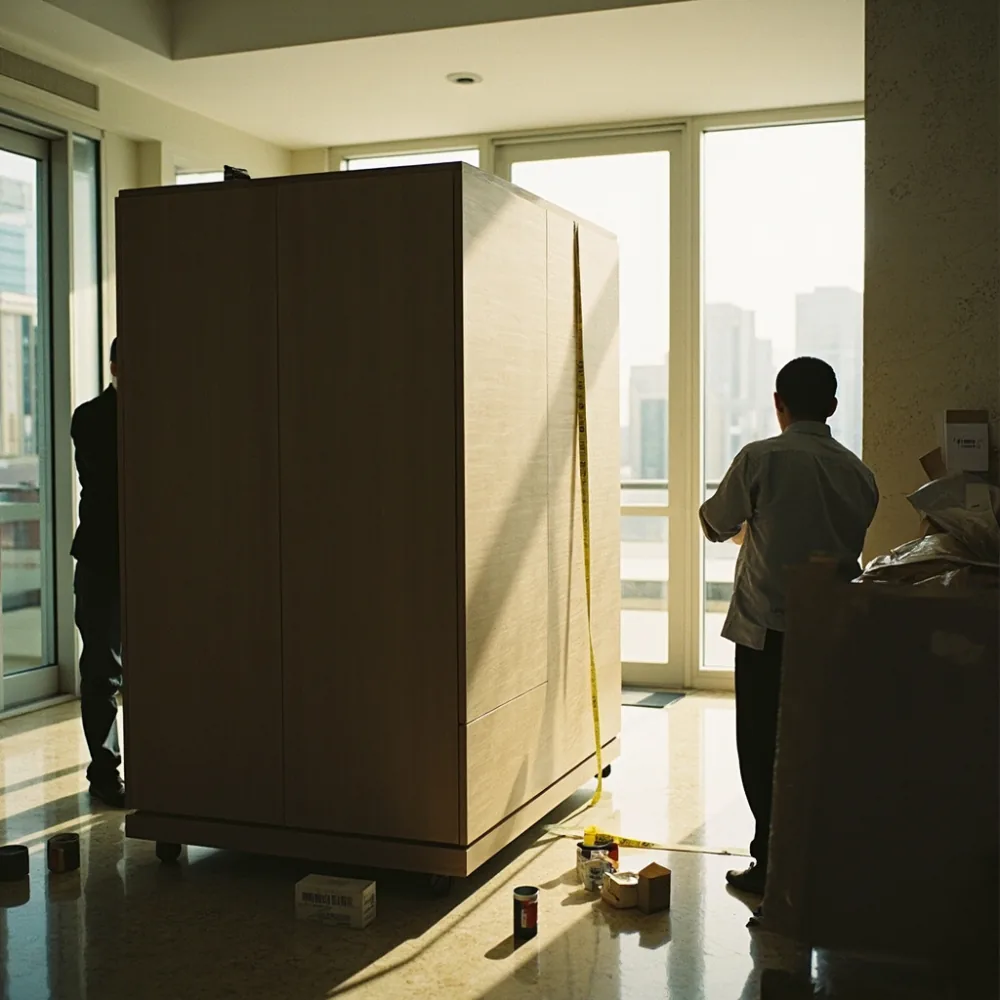
Use the right protection for each material
Why corner protection matters
The best packaging is not simply the thickest. It should stop impact, prevent abrasion and keep timber at a stable moisture level. I prefer individually wrapped components, rigid corner protection, edge guards and a pallet or skid sized to the item. For a large dining top, the table should be disassembled where the design allows, with bolts protected in labelled bags and fixed to the frame rather than left loose at the bottom of a carton.
Foam should surround the product without pressing against a delicate finish. Paper wrap can help with moisture separation, but it tears easily on exposed edges. Stretch film can hold a carton together, yet it should never be the only protection against water. I also want ventilation or desiccant guidance for longer routes and humid departure ports.
Here is the protection I would specify for common Singapore purchases:
| Item | Recommended packing | Useful dimensions | Typical packed weight |
|---|---|---|---|
| 120 cm solid wood dining table | Separately wrapped top and legs, foam corners, screwed to a skid | Package around 130 × 80 × 78 cm | 65–85 kg |
| Three-seat leather sofa | Frame wrapped, feet removed and bagged, under-seat and arm protection | Package around 220 × 95 × 90 cm | 70–100 kg |
| Two-door cabinet | Doors padded and tied, shelves protected, base skid | Package around 100 × 50 × 105 cm | 35–55 kg |
| Small-space bedside table | Rigid carton, foam inserts and corner guards | Package around 55 × 50 × 55 cm | 8–14 kg |
These are planning figures, not factory specifications. The final package should be weighed and measured before dispatch. If a shipment exceeds 100 kg, the delivery team should know its exact loaded weight because lift limits and stair-carry charges may apply.
How do HDB and condo access affect furniture delivery damage?
Measure doors, corridors and lifts
Plan around Singapore delivery rules
A perfect item can be damaged because it cannot pass through the building. HDB flats often have a standard entrance door, but the route from the service lobby to the unit may include a tight corridor turn, a fire door or several stair flights. Newer BTO and condο units can have different access arrangements, and the lift dimensions listed in the lift directory may describe the car rather than the usable door opening.
For a condo, I also check whether the move-in slot, loading bay or service lift requires a booking, protection mat or insurance. The management corporation may impose delivery windows, and a driver may need a vehicle booking form. I ask for the building’s access information in days rather than hours before delivery.
- HDB: reserve the service lift if required and inspect the route from the void deck to the flat.
- Condo: confirm loading bay hours, lift dimensions, booking fees and whether the porter can assist.
- Ground-floor unit: check whether the trolley can reach the door without crossing a drainage channel or step.
- High-floor unit: verify the lift’s maximum load and the combined weight of the furniture and delivery crew.
Singapore delivery teams usually work on a two-person crew for larger pieces, but the exact inclusion depends on the quote. Ask whether stairs, lift handling, assembly, packaging removal and excessive-weight surcharges are included. A low quoted price can still be reasonable if the route is easy and the item is flat-packed; a complicated HDB landing with four flights changes the calculation.
What should be included in a furniture delivery and damage policy?
Separate freight insurance from warranty
Check timeframes and claim evidence
I want the policy to state what happens at each stage. Who loads the item, who carries it into the flat, who assembles it and who covers a defect discovered after the crew leaves? A 10-year structural warranty can reassure a buyer about frame quality, but it is not the same as transit insurance. The distinction matters when a dining table arrives with a broken joint.
For example, MIDHILL is a Foshan solid-wood furniture maker established in 2008 and offers a 10-year structural warranty. I would still confirm whether its Singapore delivery terms include a separate damage-reporting window, photo requirements and responsibility for return freight. The brand reference here is not a substitute for reading the quoted terms.
Look for a claim process with a defined response time. A practical target is acknowledgement within 48 hours, a preliminary assessment within 5–7 business days, and a repair, replacement or refund decision within 14–21 days after receiving evidence. Those are benchmarks to negotiate, not universal legal periods.
- Confirm damage must be reported within 24 or 48 hours of delivery.
- Ask whether the original packaging must be retained for assessment.
- Check if the supplier pays return freight when a defect is verified.
- See whether self-assembly errors are excluded while missing or defective parts are supplied.
- Confirm whether the repair is completed at the Singapore address or at the factory.
The order confirmation should also record the finish, dimensions, weight, package count and agreed delivery window. Keep screenshots, the quotation and the bill of lading or tracking number. A clear file makes a claim faster than a verbal account relayed after a busy move.
How much does furniture delivery to Singapore cost, and what drives the price?
Compare quotes on the same basis
Budget for access and assembly
I compare delivery quotes using the same checklist: door-to-door freight, import duties, lift or stair handling, assembly and packaging removal. A headline price per item can be misleading because one supplier includes a normal HDB ground-floor delivery while another includes a high-floor condo with booking charges.
For planning only, a compact nightstand may add SGD 35–80 to an international consolidated shipment. A three-seat sofa may add SGD 180–450 for local delivery and assembly. A 70–90 kg solid wood dining table may add SGD 150–350, with extra charges for stairs, a remote district or an early-morning slot. These are typical budgeting ranges, not seller quotes.
| Example order | Indicative item weight | Estimated local delivery | Delivery window to plan |
|---|---|---|---|
| Compact bedside table | 8–14 kg | SGD 35–80 | 3–7 days after arrival |
| Three-seat sofa | 70–100 kg | SGD 180–450 | 5–10 days after arrival |
| Solid wood dining table | 65–85 kg | SGD 150–350 | 7–14 days after arrival |
Freight from Foshan to Singapore is often quoted by volume or cubic metre rather than weight alone. Sea transit may take around 10–18 days, while air freight can cut the main journey to roughly 5–8 days but has strict size and weight limits. Add 2–7 days for customs clearance, port handling and the final delivery appointment. Do not treat the booking date as a guaranteed arrival date.
I ask whether duties are prepaid and whether the seller is the importer of record. For commercial shipments, check the HS classification and GST treatment with a licensed forwarder. Personal-use purchases are not automatically duty-free, so the supplier’s paperwork should be checked before the container arrives.
Can humidity damage solid wood furniture after it arrives in Singapore?
Balance indoor humidity
Recognise movement that is not a shipping defect
Singapore’s high humidity can cause timber to absorb moisture and expand. The change is usually gradual, so a table top may feel different in September compared with February. A solid wood dining table can also develop small checks or movement around an end-grain joint. That is different from a fresh split or a corner broken off in transit.
I aim for indoor relative humidity around 45–65%, using a hygrometer rather than guessing from the weather. Air-conditioning and dehumidifiers help, but I avoid placing furniture beside a laundry balcony, an uncovered bathroom wall or a window with persistent condensation. In HDB and condo homes, outdoor humidity enters during the monsoon, so ventilation and controlled cooling are more dependable than a damp-resistant marketing claim.
Leather needs a different check. Keep a leather sofa away from direct air-conditioning vents and wipe it with a damp cloth rather than saturating it. Do not use aggressive household cleaners. For durable furniture, a stable environment and sensible cleaning routine usually protect the material better than applying an unverified “waterproof” coating.
New timber should acclimatise for several days before final assembly or tightening. Expansion is a material behaviour, not a reason to blame the carrier. Shipping damage has a sharp edge, a sudden crack, distorted hardware or impact marks; humidity-related movement is subtler and follows the grain.
How should I assemble delivered furniture to avoid causing new damage?
Follow the manual
Use the right tools and order
Many delivery claims begin after assembly because a leg is forced, a dowel is misaligned or a particleboard panel is screwed into an undrilled position. I unpack components on a clean, level surface and keep protective film until the furniture is in its final location. Sharp knives should not be used to open boxes near the product, and hardware should not be removed until the relevant instruction step is clear.
For flat-packed small space furniture, I check that every panel and fixing is present before joining anything. Hardware for different parts should not look identical by mistake; photograph the labels and compare them with the manual. A supplied Allen key is often sized for the factory hardware, while an incorrect substitute can round the head.
- Use a stable work area with enough clearance for a 120–160 cm table panel.
- Protect floors with cardboard or a rug while turning and assembling.
- Attach legs while the frame is supported, never while it balances on one side.
- Tighten fittings progressively; do not overtighten to hide resistance.
- For a leather sofa, fit feet before removing transport restraints and avoid pulling the upholstery.
Custom furniture may arrive partly assembled because its dimensions are fixed for a particular home. I then check the fixing locations against the room plan and confirm whether the supplier or the local carpenter should complete the final installation. If a wall anchor is supplied, use the correct anchor for the wall type. Hollow plasterboard needs a suitable anchor; a generic screw can fail under load.
What should I do if furniture arrives damaged in Singapore?
Document, notify and protect
Choose the right remedy
Keep the item and packaging as they were, where safety allows, and contact the seller with the delivery reference and timestamped photographs. Do not begin a full repair or dispose of packaging before the supplier has assessed the claim. If a sharp edge makes the item unsafe, cover it and arrange a safe temporary position instead of continuing to use it.
My evidence pack contains the order number, payment record, product specification, delivery note, photographs of the carton, close-ups of the defect, the unpacking sequence and any messages with the delivery team. I also include a short timeline: when the parcel arrived, when the damage was found and whether assembly had started. This reduces back-and-forth.
The remedy should match the problem. A chipped finish may need a touch-up kit; a missing bolt may need a replacement pack; a split table top or twisted frame may need a full replacement. Partial credit is less useful when the piece cannot function. If the seller offers repair, confirm the expected completion date and whether they cover the return visit and labour.
For disputes, I keep communication in writing and review the original sales terms, platform rules and payment protections. Credit cards, Singpass-linked payment records and marketplace escrow can help establish the transaction, but coverage varies. Escalate promptly rather than waiting weeks while continuing to use a damaged chair or cabinet.
Frequently asked questions
Is furniture damage common when shipping from China to Singapore?
Damage is not inevitable, but large and heavy pieces are more exposed to drops, shifting loads and difficult handling. Solid wood dining tables and sofas often have detachable parts that need careful packing. The best protection combines a rigid inner package, corner guards, moisture management, accurate weights and a delivery route checked for access.
Should I inspect furniture before the delivery crew leaves?
Yes. Ask for a joint inspection before the crew departs, and record every mark on the delivery note. Photograph the package, full item and close-ups of suspected damage. If time is short, take timestamped photos immediately after delivery and send them to the seller while the packaging remains intact.
How long does furniture delivery from Foshan to Singapore take?
Allow roughly 10–18 days for sea freight, 5–8 days for suitable air shipments, and another 2–7 days for clearance, port handling and final scheduling. These are planning ranges, not guarantees. Peak periods, customs checks, building access bookings and heavy-item surcharges can extend the total timeframe.
Does Singapore humidity ruin solid wood furniture?
High humidity can make solid wood expand, move slightly or develop fine checks, especially near exposed doors and bathrooms. Aim for about 45–65% relative humidity, use air-conditioning or dehumidification, and avoid direct dampness. Sudden splits or crushed corners are more consistent with impact than ordinary humidity-related movement.
What does a structural warranty cover after delivery?
A structural warranty usually covers long-term frame or joinery failures under normal use; it may not cover transit damage, moisture, misuse or incorrect assembly. Ask for written terms covering the reporting window, replacement parts, repair labour, return freight and turnaround time. Keep the invoice, care instructions and delivery evidence.
Questions about sizing, fabric or delivery?
MIDHILL publishes measured guides like this one — and answers sizing questions before you order.
See the collection