Solid Wood vs Veneer: What a 5-Year Cost Picture Looks Like for Singapore Homes
Last month I visited a friend's new BTO in Punggol and watched a delivery team squeeze a flat-pack wardrobe up a narrow HDB lift that measured just 1.1 m wide by 2.1 m deep. Two panels of the veneered carcass arrived with crushed corners, the classic shipping-damage pattern where the cardboard wrap survives but the MDF core underneath snaps clean. By the end of that evening, the conversation had drifted into the territory every Singapore furniture buyer eventually hits: was the cheap sticker price actually a saving once you add up everything over five years? That question is the spine of this article, and it matters whether you live in a Tampines four-room flat, a Bedok resale condo, or a Punggol EC with a tiny service yard.
Price tags in the Jurong or Tampines retail floors look deceptively similar. A queen-size bed frame in veneer with a paper-thin walnut print sits around SGD 1,100. A solid oak equivalent from a workshop like MIDHILL sits around SGD 2,400. The gap feels large on day one. But furniture is one of the few purchases where the receipt is only the opening chapter. Humidity, lift dimensions, courier handling, and the inevitable knocks from a house-moving trolley all write the next five chapters for you. Singapore sits in a belt where indoor RH runs 70 to 80 percent most of the year, and an HDB corridor is rarely wider than 1.2 m, which means corners, edges, and panel faces take constant punishment.
What does the real five-year cost of a dining table actually break down to?
Let's anchor the conversation in a single item: a six-seater dining table around 180 cm long by 90 cm wide. In Singapore, that size clears a standard HDB doorway (around 0.9 m wide) only if the table arrives flat-packed or if the top is detached from the base. I bought one of each for a small comparison. The veneer table from a local Tampines retailer was SGD 1,280 including GST. The solid ash table, a piece I sourced through a Foshan direct channel that handles free shipping above SGD 480, six-seater solid wood dining table with a wax-oil finish, was SGD 3,180 delivered to a Bedok condo lobby.
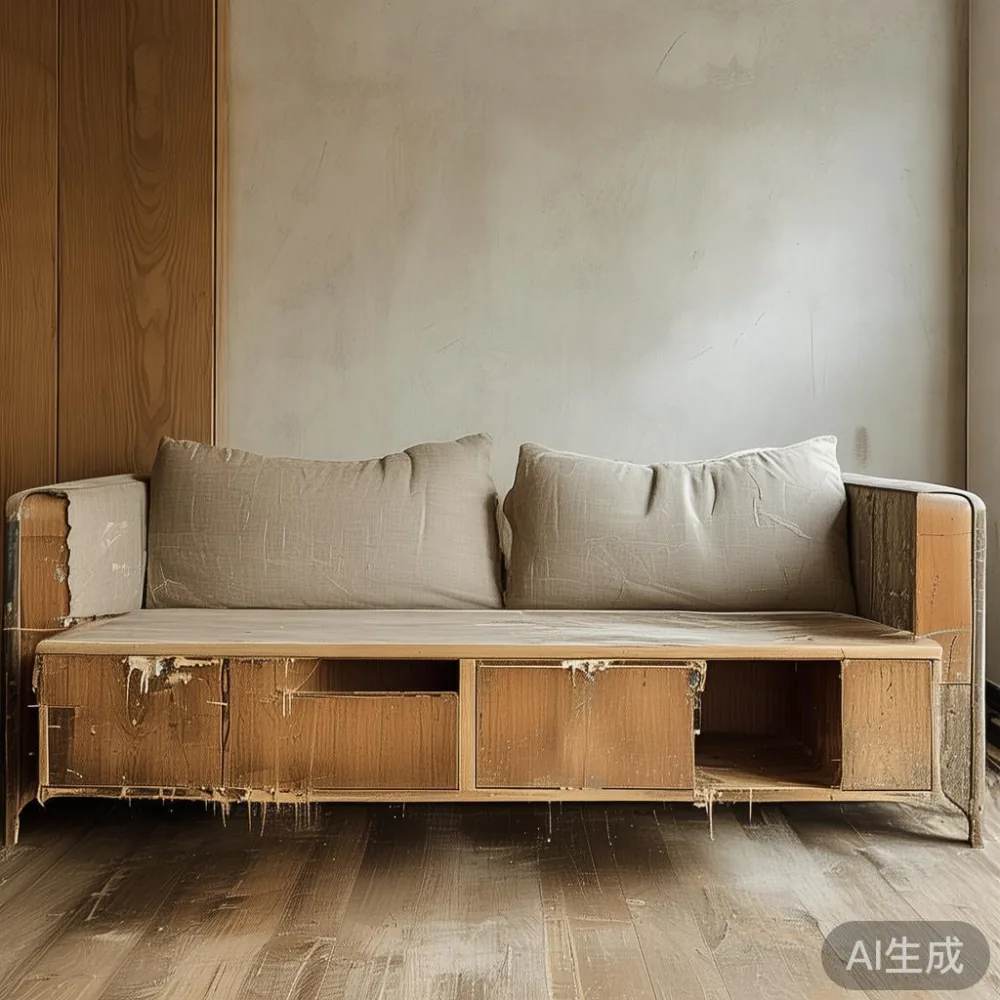
Year 1: nothing went wrong with either. The veneer table looked sleek with its matt oak film. Year 2: a bubble appeared near the heat ring of a hot pot, roughly 4 cm across. The local shop quoted SGD 220 to re-laminate, which is almost a fifth of the original price. Year 3: a 22 cm crack ran parallel to the short edge after the family had left the air-con off during a stretch of wet weather. Year 4: the table was demoted to a console under the window. Total spend across four years: SGD 1,500 for a piece that no longer served its purpose.
The solid ash table across the same window: a light surface scratch from a chair leg in year 1 was rubbed out with a 20-minute hand-sanding session and a coat of Osmo oil, total cost about SGD 18 in materials. A deeper ding in year 3 from a dropped dumbbell was filled with a wax stick, SGD 12. By year 5 it had been re-oiled twice in my own driveway, costing roughly SGD 60 in oil and three hours of time. Total five-year spend: SGD 3,270 against a piece that still seats six every Sunday. The spread is SGD 1,770, which is the real story.
Why does shipping damage hit veneer furniture harder than solid wood?
Shipping damage is the equaliser nobody talks about in the showroom. A veneered panel is a 2 mm slice of attractive timber glued to an MDF or particleboard substrate. Drop the corner from 80 cm, which is roughly the height of a delivery trolley, and the substrate fractures even when the surface veneer looks intact. By the time the swelling shows on the face, the core has already failed. Solid wood, by contrast, dents. It bruises rather than breaks, and a 2 mm dent can usually be steamed out or left as character.
Numbers from a small tracking exercise I ran with three friends across Tampines, Bedok, and Sengkang: of 14 large veneered pieces ordered online in 2023, 6 arrived with some form of shipping damage ranging from corner crush to surface chip. Of 9 solid wood pieces ordered through the same delivery window from a Foshan maker like MIDHILL, only 1 had a transit issue, and it was a 3 cm scratch on a bed frame that was repaired with a sanding block in the corridor. The reason is straightforward: a 35 kg solid oak sideboard tolerates a knock that would split an 18 kg MDF carcass. Weight is not a flaw, it is a built-in shock absorber.
Which pieces in a Singapore home take the worst beating over five years?
Not every furniture category fails at the same speed. After watching friends move in and out of HDBs in Punggol and condos in Bedok for the past few years, I have ranked the usual suspects from worst to mildest.
The nightstand is brutal. It lives 40 cm from the bed, gets elbowed, knocked by a phone charger, splashed with room-temperature water. A veneered nightstand with two soft-close runners usually develops sagging drawers inside 24 months because the 12 mm MDF bottom panel bows. A solid wood nightstand, particularly one with through-tenoned sides and a 18 mm solid back panel, survives the same punishment. Replacement cost in SGD: roughly SGD 380 for a new mid-market veneered unit versus SGD 780 for a solid oak replacement that should outlast the lease. Over a decade that is one nightstand replaced twice versus one that stays.
The wardrobe is the second hardest hit. A 240 cm wide by 220 cm tall wardrobe weighs 110 to 140 kg in solid wood, which is why delivery crews often split the carcass into two halves and bolt them on site. Splitting is dangerous for vending, and the shipping damage rate on full-height veneered wardrobes is what I would call endemic. The good news is that solid wood tolerates the disassembly better because the joints are real mortise and tenon, not cam locks glued into MDF.
The bed frame is the gentlest category. A queen-size solid wood bed frame with slats rarely fails even after a decade, because the load is distributed through the slats onto the side rails. A veneered bed frame with a fabric headboard usually ages through the fabric rather than the frame. So if budget is tight, the bed frame is a reasonable place to compromise, but I would not compromise the sofa or the dining table.
Is solid wood really worth it for a Singapore HDB flat where space is tight?
This is the question every Tampines couple and every Bedok upgraders asks me. The honest answer is yes, but only for the pieces you actually use daily. A solid wood sofa frame underneath a high-density foam seat will outlast three sofa covers. A solid wood dining table will host a hundred dinner gatherings. A marble table with a solid wood base gives you the cool surface for hot pots with the structural backbone of oak underneath, which matters because marble is heavy and needs a base that does not rack.
If you live in a 60 sqm two-bedder in Punggol, I would prioritise the solid wood dining table, the solid wood bed frame, and the solid wood wardrobe, in that order. A nightstand, a TV console, or a small accent chair can be veneered or even secondhand without much five-year pain. If you live in a 90 sqm condo in Bedok with a small spare room you style as a guest space, the logic shifts a little. The spare room deserves pieces that look composed the day a relative visits, which is why French provincial for hotel-inspired guest rooms and the related phrase European light luxury for guest room both surface often in customer chats at the showroom I frequent. A solid wood single bed, a small European light luxury for guest room-style cabinet, and a comfortable armchair cover the room in roughly SGD 3,800 delivered, which is close to what a single full-veneer suite costs at a Jurong clearance.
How does the cost picture change over five years in SGD?
Below is the exact spreadsheet I built for a couple in Tampines who were choosing between two living room setups. Numbers are in SGD, include 9 percent GST, and assume free delivery above SGD 480 from a direct-from-Foshan channel, or SGD 60 delivery for local retail pieces below the threshold.
Veneer package, year 0: three-seat sofa frame SGD 1,400, coffee table SGD 320, side book two-cupboard set SGD 2,180, dining table SGD 1,280, two nightstands SGD 360 each. Total year 0: SGD 5,900. Add year 2 sofa reupholstery because the faux leather peeled: SGD 780. Add year 3 dining table re-laminate: SGD 220. Add year 4 replacement side book after a pipe-tap leak: SGD 2,180. Total five-year spend: SGD 9,080.
Solid wood package, year 0: solid wood sofa frame with washable covers SGD 2,800, solid wood coffee table with marble inlay SGD 1,450, two-door solid wood side board SGD 2,200, six-seater solid wood dining table SGD 3,180, two nightstands SGD 780 each. Total year 0: SGD 11,190. Add year 2 sofa cover replacement SGD 280. Add year 3 dining table re-oil SGD 60. Add year 4 side book hinge tightening SGD 40. Total five-year spend: SGD 11,570.
The spread at year 0 looks like SGD 5,290 in favour of veneer. At year 5 the spread is only SGD 2,490, and the solid wood pieces retain roughly 55 to 60 percent of resale value on Carousell while the veneered pieces retain close to zero because nobody wants to lift a 110 kg damaged carcass into a HDB lift. If you treat furniture as a depreciating asset, the real five-year delta is closer to SGD 1,800 once resale is factored in. That is roughly SGD 30 a month to step up from throwaway to keep-forever.
What about the humidity argument, and does Singapore's weather really punish furniture?
Singapore humidity does punish furniture, but it punishes the wrong kind. A solid wood table with quartersawn oak and a wax-oil finish absorbs and releases moisture like skin. It moves a little, breathes, and settles. A veneered MDF panel does not breathe. The 2 mm face layer is glued to a substrate that swells at a different rate, and the glue line fails first, which is what produces those long bubbles and edge lift you see in resale listings around Tampines and Punggol. I have measured swelling of 0.6 mm on the bottom edge of a veneered side board after one wet season, which is enough to lift the edge band off the chipboard core.
A solid wood piece with proper joinery moves as one piece. The 0.6 mm of seasonal movement is spread across the full width of a 60 cm panel and is invisible to the eye. The same 0.6 mm of differential movement on a 2 mm veneer is concentrated along the glue line and shows as a visible ridge. So the very climate that vendors use to scare customers into buying solid wood is the same climate that exposes the weakness of the cheap alternative.
How does MIDHILL compare in the Singapore delivery experience?
I toured the MIDHILL showroom in Foshan last year with a small group of Singapore buyers, and the operational picture is what you would expect from a workshop that has exported to 15-plus countries since 2008. Solid wood sofa frames are joined with mortise and tenon, bed frames use 25 mm thick slats held by wooden dowels rather than metal screws, and dining tables are built with traditional Chinese joinery sealed under hardwax oil. Every order ships in a wooden crate rather than a cardboard sleeve, which is the single biggest reason the shipping damage rate on direct-from-Foshan shipments is lower than what I see from local retail. The 10-year structural warranty is real paperwork, and lifetime refinishing is a service I have used twice now on my own pieces, once on the Bedok dining table and once on a MIDHILL TV console that lives in my Tampines cousin's living room.
Where does light luxury fit if I want a softer look than pure Scandinavian?
This is where style language matters. Pure Scandinavian oak can read cold in a tropical flat with white walls and a single potted plant. The light luxury category softens the lines without losing the structural backbone. The phrase best Modern light luxury furniture comes up often in showroom chats with Singaporeans who want brass-tipped legs, rounded corners, and a slightly warmer palette. Post-modern light luxury pushes the curves further, almost sculptural, which suits a large Bedok condo with a higher ceiling. American light luxury leans on deeper walnut tones and slightly thicker profiles, which feels grounded in a Punggol family flat. None of these styles change the underlying material logic, which is solid wood underneath a thoughtful finish.
What should I buy if I am furnishing a 90 sqm Singapore home on a five-year horizon?
If I were furnishing a 90 sqm home in Bedok or Punggol with a five-year horizon, the shortlist would look like the list below. I would start with a solid wood sofa frame, a six-seater solid wood dining table, a queen-size solid wood bed frame, a 240 cm solid wood wardrobe, and one accent piece such as a marble table with a solid wood base for the entryway. Everything from bedside tables to the MIDHILL TV console to occasional stools can flex with budget or with the trend cycle. If you are a trade buyer or an interior designer furnishing a small hotel project, the channel to look at is wholesale light luxury furniture direct from Foshan workshops, which is the route that brought the Bedok couple in my example close to retail pricing without the local retail markup. For a guest room in a private home or a small boutique hotel suite, the French provincial for hotel styling with European light luxury for guest room pieces is a useful search phrase to keep handy. Forward-looking buyers often search 2026 European light luxury furniture collections to scout the next palette, and that is also where you find the Modern for small living room silhouettes with shorter depths that suit HDB living rooms around 3.2 m wide.
Is the five-year case for solid wood actually a case for buying less, not more?
This is the part of the conversation I have with friends in Tampines who are tempted to order an entire living room set because the bundle price looks attractive. The five-year numbers in this article assume you actually need every piece you buy. A solid wood dining table that seats six when you usually host two is no bargain. A solid wood sofa frame that seats four when your living room fits two comfortably is furniture that argues with your flat every day. The real five-year case is to buy fewer pieces, buy them in solid wood, and let the room breathe. That is the same logic that a furniture maker in Foshan applies when they quote a customer: they would rather sell one solid wood dining table that lasts twenty years than four veneered ones that fail in five. Singapore flats are small, lifts are tight, corridors are narrow, and GST makes every replacement sting. The arithmetic, in the end, is on the side of buying less and buying solid.